

When was the last time you planned something with your partner that was not already on the calendar?
Not a birthday dinner, an anniversary, or the usual night on the couch. Something you both actually looked forward to.
Work, errands, and ordinary stress make that easy to skip. You love each other. You share a life. You probably spend plenty of time in the same room. How often do you do something that makes the relationship feel like it still has a pulse?
That is the pitch behind the 777 rule, a trend that tells couples to put quality time on a schedule.
Does the schedule itself work? Do you need it to have a good relationship?
Here is what the rule asks for, what the research actually supports, and how to keep the useful part without treating the numbers like a law.
What is the 777 rule?
The 777 rule is a guideline with three intervals:
- Every 7 days: go on a date.
- Every 7 weeks: spend a night away together.
- Every 7 months: take a vacation together.
The point is to make time together a regular habit, not something that only happens when a birthday or an anniversary shows up.
A weekly date gives you something to anticipate. A night away gets you out of the usual rooms. A trip is shared memory with the household to-do list left behind.
It spread because it is easy to remember. “Spend more time together” is vague. Three numbers feel like a plan.
The 777 rule is a popular guideline, not a tested formula. There is no established evidence that these exact gaps are what a relationship needs.
If the numbers are not magic, the interesting part is the habit underneath them.
Why quality time matters in a relationship
Being in the same room and actually connecting are not the same thing.
You can share a whole evening, a meal, a show, and the grocery list without feeling any closer than you did at lunch.
A relationship can get very good at running a household and still leave little room for curiosity, play, or romance.
Research on new experiences together is the part of this trend that has something solid under it.
A 2000 paper in the Journal of Personality and Social Psychology looked at couples who did something new and exciting together. Arthur Aron, Christina Norman, Elaine Aron, Colin McKenna, and Richard Heyman ran surveys and laboratory experiments.
Couples who did a novel, stimulating activity showed a bigger lift in relationship quality than couples who did a mundane task. The useful detail is that they were not just logging more hours side by side. They were doing something different. Couples' shared participation in novel and arousing activities and experienced relationship quality.
That does not prove every couple needs a weekly date or a vacation on a timer. It does support the idea the 777 rule is reaching for: shared experiences, not only shared logistics, are part of keeping a relationship engaging.
Can routine make a relationship feel boring?
Routine is not a flaw. Knowing how they take their coffee, having a usual restaurant, spending Sunday morning the same way: that is part of feeling safe with someone.
The strain starts when familiarity leaves no room to discover anything.
A 2023 paper in the Journal of Social and Personal Relationships looked at relational boredom directly. Kiersten Dobson, Sarah Stanton, Rhonda Balzarini, and Lorne Campbell ran three studies with couples. Partners tended to overestimate each other's boredom, and they also tracked it. The costly pattern was accuracy at the high end: when someone correctly saw that their partner was very bored with the relationship, both people tended to report lower relationship quality. Are you tired of “us”? Accuracy and bias in couples' perceptions of relational boredom.
Boredom here is not one quiet Tuesday. It is the relationship itself feeling flat, often enough that both of you can feel it.
A dull evening is not a warning by itself. Long relationships include tired weeks, repeated chores, and nights when nobody has the energy to invent a plan.
What matters is the pattern. If you rarely look forward to time together, you have stopped trying anything new, or you are living next to each other more than with each other, it is worth making a deliberate effort to reconnect.
Does the 777 rule actually work?
The exact formula has not been shown to be a proven way to improve a relationship.
Jobs, small children, money, or health can make a night away every seven weeks unrealistic, and a trip every seven months even more so.
That does not mean the relationship is failing.
Treating the rule like a checklist can work against it. If date night becomes one more task in an already full week, it adds stress instead of closeness.
Use it as a reminder, not a requirement.
You do not need every number. You need a rhythm both of you can keep, one that still gives the relationship attention.
For some people that is a weekly dinner and an occasional weekend away. For others it is a walk after work, a homemade dinner with the phones in another room, or one new thing at home on the weekend.
The schedule that works is the one you will still be doing in two months.
How to apply the 777 rule without spending a fortune
The trend feels expensive because people hear “date” and picture a restaurant, a hotel, and a flight.
Time together does not have to cost much.
- Make the weekly date something you want to reach. No reservation required. Cook a dish you have never made, walk a neighborhood you usually skip, play a game, or take a long walk somewhere you like. Do it on purpose, instead of defaulting to whatever is easiest. Take turns choosing. Something to anticipate can change an ordinary week.
- Turn an ordinary night into a different one. You can stay home. Recreate a restaurant meal, pick a theme for the movie, learn a recipe, or play something that gets you talking. The aim is not a spectacular evening. It is one that does not feel like last Tuesday.
- Plan a small outing instead of a full trip. If a night away every seven weeks is not realistic, shrink it. A nearby town for an afternoon. A local place you have never been. A few hours with the usual chores parked. You can also set a little money aside each month for a later trip. Planning it together is part of the pleasure.
- Pick something you both actually want. This is where a lot of couples stall. One person wants a hike. The other wants the couch. One wants a new restaurant. The other wants to cook. Look for the overlap, or a way to enjoy the other person's interest without pretending you love it equally. The plan that gets used is the one both of you can say yes to.
- Let the time be about each other. The activity is only half of it. If the whole date is work messages, a feed, and the household list, you missed the point. Phones down for a stretch. Ask something you do not usually ask. Say what you have been thinking about. Attention is what makes the time feel like time together.
The hardest part is coming up with ideas
You both agree this weekend should be different. You have the time. You are willing. You might even be looking forward to it.
Then Friday arrives.
“What do you want to do?”
“I don't know. What do you want to do?”
You name a restaurant. They are not in the mood. They name a movie. You have already seen the ones you wanted. Food gets ordered. The weekend looks like the last one.
That is often a shortage of ideas that fit both of you, not a shortage of interest.
The fix is not more pressure to be creative on an empty Friday. It is making a decent idea easier to find.
Start from what you both like, what you feel like tonight, and a few options you would not have invented alone. You do not need an elaborate plan every week. One good idea can turn an ordinary evening into something you remember.
How Charmlet can help you put the idea into practice
The 777 rule tells you to make time. It does not tell you what to do with it.
Couple activities in Charmlet is for a relationship you are already in. Add the person from WhatsApp, iMessage, or Messenger and set the relationship. Then pick the kinds of activities you both like, and highlight the ones you want this time. Suggestions draw on both profiles, so the plan is about the two of you rather than a generic date list. A short note can steer it: stay in, keep it cheap, cook together.
Maybe you want an easy night at home. Maybe you want something different this weekend. Or you are tired of the same Friday conversation about what to do.
Ideas for a night at home are on the free plan. Ideas for going out are part of Charmlet Pro.

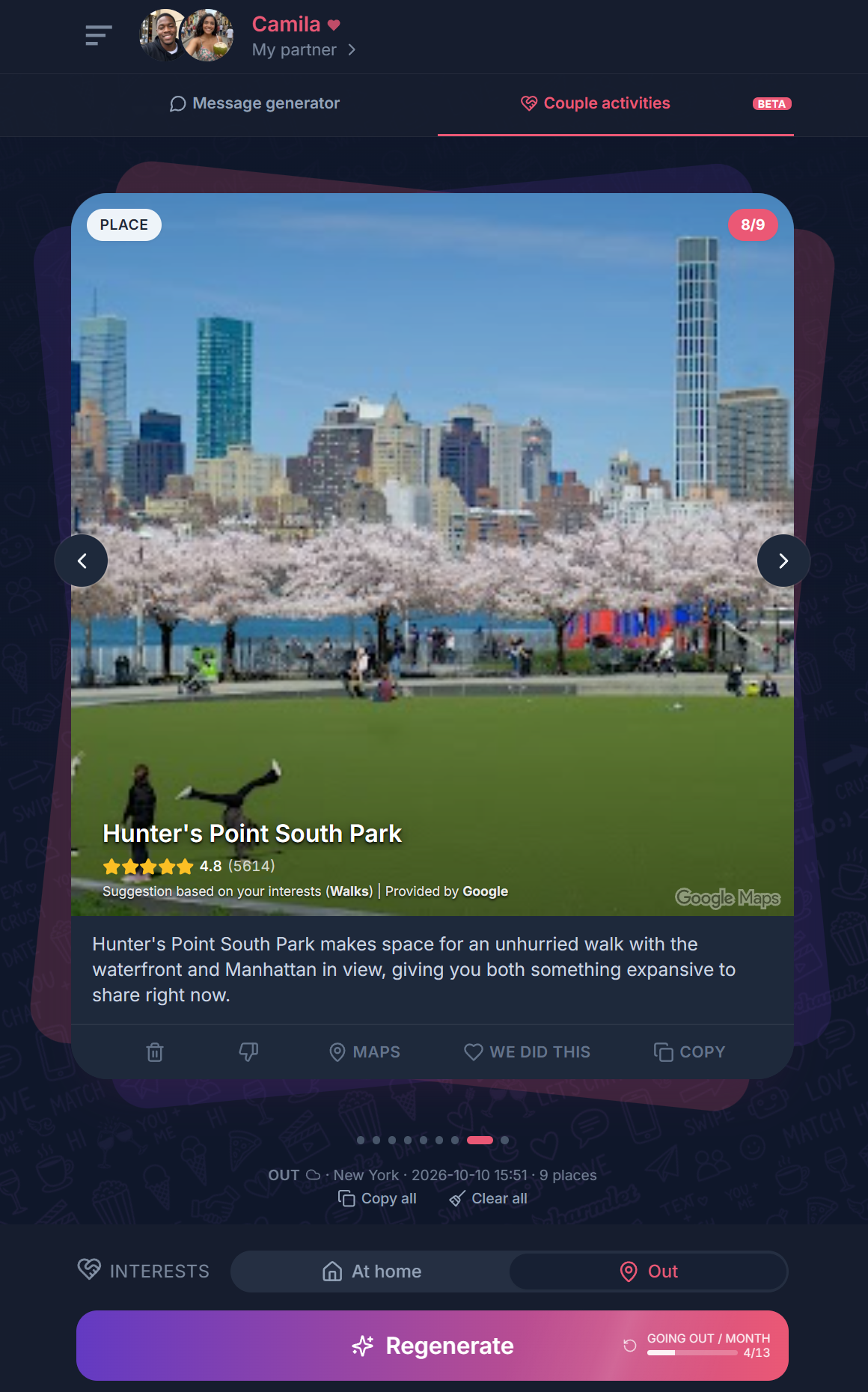
You do not need the next anniversary, and you do not need a strict seven-day clock. The aim is a plan you would both enjoy, so the time together is something to look forward to instead of another chore.
You still choose. Charmlet does not book the plan or send a message for you.
Forget the numbers. Focus on the connection.
The appeal is easy to see. Life gets busy, and a simple reminder to put the relationship on the list is useful.
The numbers are not what makes it work.
A weekly date will not fix a conversation you are avoiding. A weekend away will not replace closeness. An expensive trip is not automatically more meaningful than a quiet night you actually spend together.
What matters is a steady effort to stay connected: new things, real questions, and experiences you share. Comfort does not mean there is nothing left to find out about each other.
You do not need every week to be memorable. You need to stop letting every week be identical.
Skip the question of whether you followed the 777 rule perfectly. Ask a smaller one:
What is one thing we could do together this week that we would both actually enjoy?
Start there. One small change is often enough to feel the difference. If the blank page is the hard part, Charmlet can hand you a few options that fit. The week is still yours.
Related reading
Can routine kill a relationship? · How to stay close in a long-distance relationship · How an AI dating assistant app changed my love life