
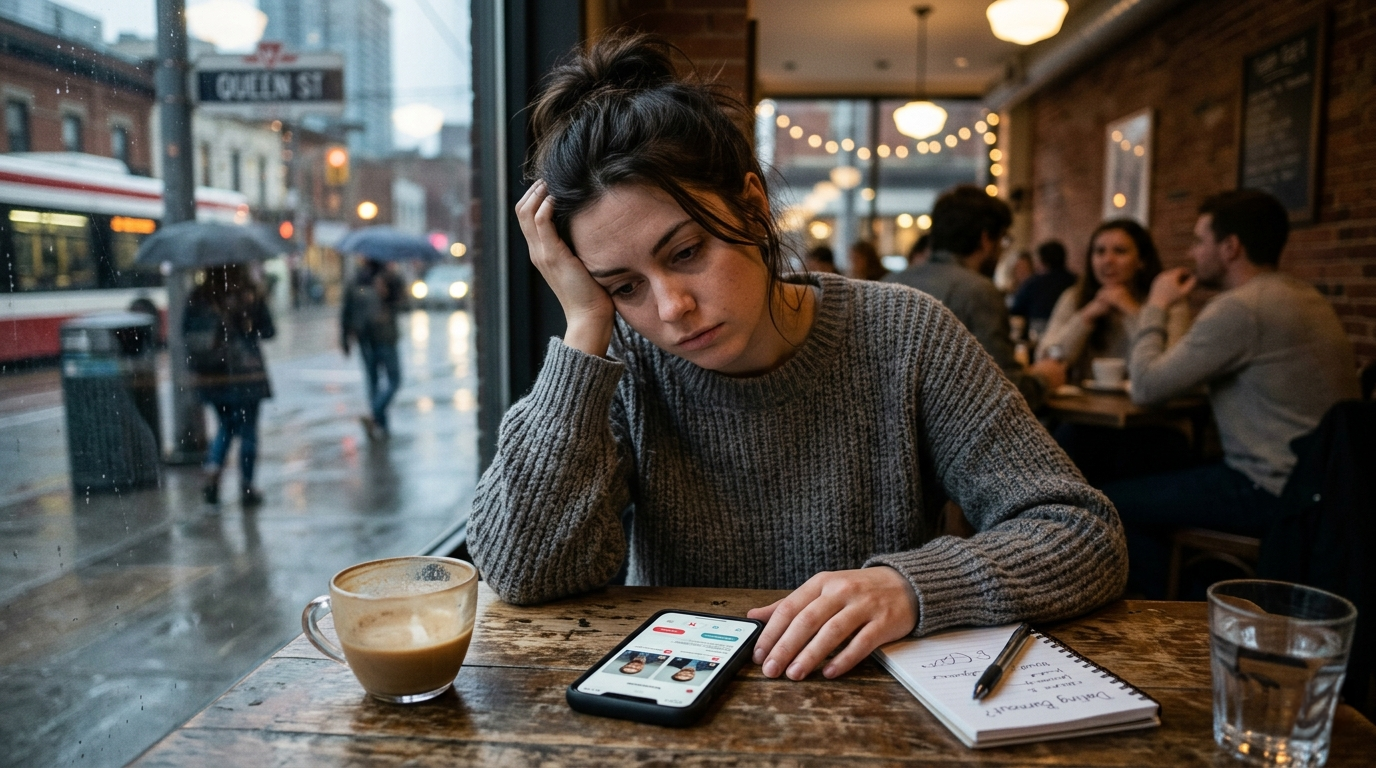
At some point, almost everyone who uses dating apps long enough hits a wall. Swiping feels mechanical, conversations feel repetitive, and the whole experience starts to feel more exhausting than exciting. You're not imagining it, and you're far from alone.
This is dating app burnout. And unlike regular dating fatigue, it has a measurable psychological profile, documented across multiple peer-reviewed studies.
What the numbers actually say
The scale of the problem is striking. A 2024 survey of 1,000 American dating app users, conducted by Forbes Health and OnePoll, found that 78% of respondents had experienced emotional exhaustion from online dating, at least sometimes. Among Gen Z users specifically, that number climbed to 79%. Men weren't immune either: 74% reported burnout-level exhaustion, compared to 80% of women.
In the UK, the behavioral shift is already visible: approximately 1.4 million people left online dating platforms between 2023 and 2024, a 16% drop in usage. Tinder alone lost over 500,000 UK users in that period.
The psychology behind the burnout
Dating app burnout isn't just tiredness. Researchers have mapped it onto the same framework used to study occupational burnout, with three core components:
- Emotional exhaustion: feeling drained by the effort of maintaining presence on apps
- Inefficacy: a growing sense that the effort isn't working, that no matter what you do, nothing leads anywhere
- Depersonalization: beginning to see potential matches as interchangeable, losing the ability to engage with them as real people
A landmark longitudinal study by Sharabi, Von Feldt, and Ha (published in New Media and Society, 2024) tracked 493 active dating app users over 12 weeks across four survey waves. The findings were sobering: users showed increased emotional exhaustion and inefficacy over time, not less. Perhaps more importantly, the study found that people who already struggled with depression, anxiety, or loneliness were the most vulnerable to burnout, suggesting that apps may amplify existing difficulties rather than help users work through them.
The choice overload trap
One of the most counterintuitive findings in this space involves what dating apps actually offer as their main selling point: unlimited options.
Research by Pronk and Denissen (2020), published in Social Psychological and Personality Science, tested what happens to decision-making when people are exposed to more and more profiles. The result: participants began rejecting potential partners at an accelerating rate, with acceptance rates dropping by an average of 27% from the first to the last profile viewed. The more options people saw, the more dismissive they became. The researchers called this a “rejection mindset.”
A separate experimental study by Thomas, Binder, and Matthes (2022) went further: exposing participants to a larger pool of potential partners didn't just affect their decisions. It actively lowered their self-esteem and increased their fear of being single. The very abundance that apps advertise as a feature turned out to be a source of anxiety and dissatisfaction.
This maps onto Barry Schwartz's classic “Paradox of Choice” framework: more options don't make us feel freer. They make us feel more paralyzed, more regretful about whatever choice we make, and more convinced we're missing something better.
What ghosting does to you
Rejection is part of dating. But the kind of rejection native to apps, sudden silence with no explanation and no closure, carries a distinct psychological cost.
Research published in Sexuality & Culture (2023) found a direct link between being ghosted on dating apps and lower self-esteem. Depression has been significantly correlated with both perceived rejection and being ghosted. And because the app format normalizes ghosting as the default way to end an interaction, users experience this kind of non-closure repeatedly and with no emotional scaffolding around it.
A systematic review published in Computers in Human Behavior (2024), which analyzed 45 studies from 2016 to 2023, found that over 85% of studies reported negative impacts of dating app use on body image, and nearly half found significant negative effects on mental health and wellbeing, including links to depression, anxiety, body dissatisfaction, and lowered self-esteem.
The design problem
Dating apps aren't neutral tools. They're built like games, with swipe mechanics, match notifications, and variable reward loops that encourage compulsive use. Research by Thomas et al. (2023) found that excessive swiping was associated with lower wellbeing, mediated by increased social comparison and compulsive behavior patterns. The design that keeps users engaged is often the same design that burns them out.
From a behavioral standpoint, dating apps increase the frequency of low-stakes social rejection while removing the contextual cues, body language, tone, mutual friends, shared environment, that normally buffer its psychological impact. The result is high-volume exposure to a specific kind of emotional stress, with few natural recovery mechanisms built in.
What actually helps
The research points toward some concrete interventions.
Take a real break, not just a day off. Uninstalling or pausing the apps for one to two weeks allows the emotional exhaustion to actually reset. Coming back with intention matters more than coming back fast.
Reduce the pool size deliberately. Given that choice overload actively degrades both your decision-making and your self-esteem, there's a strong case for being more selective upfront. Fewer swipes, more considered engagement. The research suggests this isn't settling; it's rationality.
Move toward real-world interaction sooner. Apps function best as a filtering tool, not a social environment in themselves. The longer interactions stay on the platform, the more they tend toward the mechanical conversational loops that contribute to burnout. If someone seems worth meeting, the data supports meeting them.
Lower the mental load of messaging. One underappreciated source of burnout is the cognitive labor of constantly generating new conversation. Maintaining multiple active threads, each requiring a fresh approach, creates sustained mental load that compounds over time. Tools like Charmlet address this directly, analyzing the conversation context and suggesting responses that match the tone, so you can stay present in the connections that matter rather than grinding through the mechanics of each exchange.
Audit your motivation for using the apps. The Sharabi et al. study found that users who were more autonomously motivated, genuinely wanting a relationship rather than using apps out of habit or social pressure, showed less burnout over time. It's worth checking in on why you're still swiping.
The bigger picture
Dating app burnout is increasingly well-documented, and it's not a sign of weakness or a reflection of your desirability. It's a predictable psychological response to a specific set of design conditions: high volume, high rejection frequency, low closure, and endless choice presented without context.
Understanding the mechanism makes it much easier to manage. The apps aren't going anywhere, but how you use them, and how much mental space you give them, is something you can actually control.
Sources: Sharabi, Von Feldt & Ha (2024), New Media and Society; Thomas, Binder & Matthes (2022), Computers in Human Behavior; Pronk & Denissen (2020), Social Psychological and Personality Science; Forbes Health / OnePoll (2024); Systematic review, Computers in Human Behavior (2024), 45 studies, 2016–2023.
Related reading
How to keep a conversation going · How to ask someone out on a dating app · How to get back into dating after a long relationship